Reading & writing
CP Reading & Writing Mastery
We believe that mastering the fundamentals of critical reading and writing is essential for every learner at every stage of their academic life, and beyond.
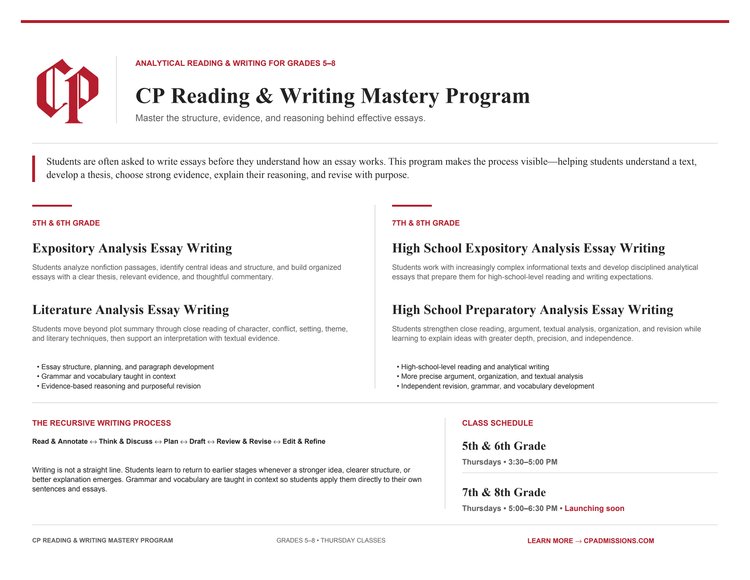
Many students are asked to write essays before they fully understand how an essay works. They may have ideas, but they do not yet know how to turn those ideas into a clear thesis, organize supporting points, select relevant evidence, or explain why that evidence matters.
The CP Reading & Writing Program makes these invisible skills visible. The goal is not simply to complete another essay. It is to develop a repeatable method students can use whenever they read, think, and write.
Expository analysis
Students read engaging nonfiction from science, history, society, and culture, then plan and write organized analytical essays.
- Read and annotate passages actively
- Distinguish main ideas from supporting details
- Form a clear and defensible thesis
- Use facts, logic, and expert opinion as support
- Revise for clarity, organization, grammar, and style
Literature analysis
Students move beyond recounting what happened in a story and examine how authors use literary choices to develop meaning.
- Analyze character, conflict, setting, and theme
- Recognize imagery, metaphor, symbolism, irony, and foreshadowing
- Develop an interpretive thesis
- Connect quotations to original commentary
- Organize a complete literary analysis essay
Class schedule
A structured, recursive writing process
Identify important ideas, unfamiliar vocabulary, structural patterns, and evidence.
Ask questions, consider interpretations, and test possible claims.
Develop a thesis and arrange supporting details in a logical outline.
Turn the plan into an introduction, body paragraphs, and conclusion.
Check that each paragraph supports the thesis and every piece of evidence is explained.
Improve grammar, sentence structure, word choice, punctuation, and style.
What happens during class?
A concentrated 90-minute core integrates close reading, annotation and comprehension strategies, grammar and sentence instruction, vocabulary in context, essay planning and guided writing, and revision and editing. The remaining class time supports discussion, analysis, feedback, and applying each week's skills.