
CP Reading & Writing Mastery
We believe that mastering the fundamentals of critical reading and writing is an essential for every learner at every stage of their academic life — and beyond.
SIGN UP FOR MORE INFORMATION
Reading, Thinking, and Writing Are Connected
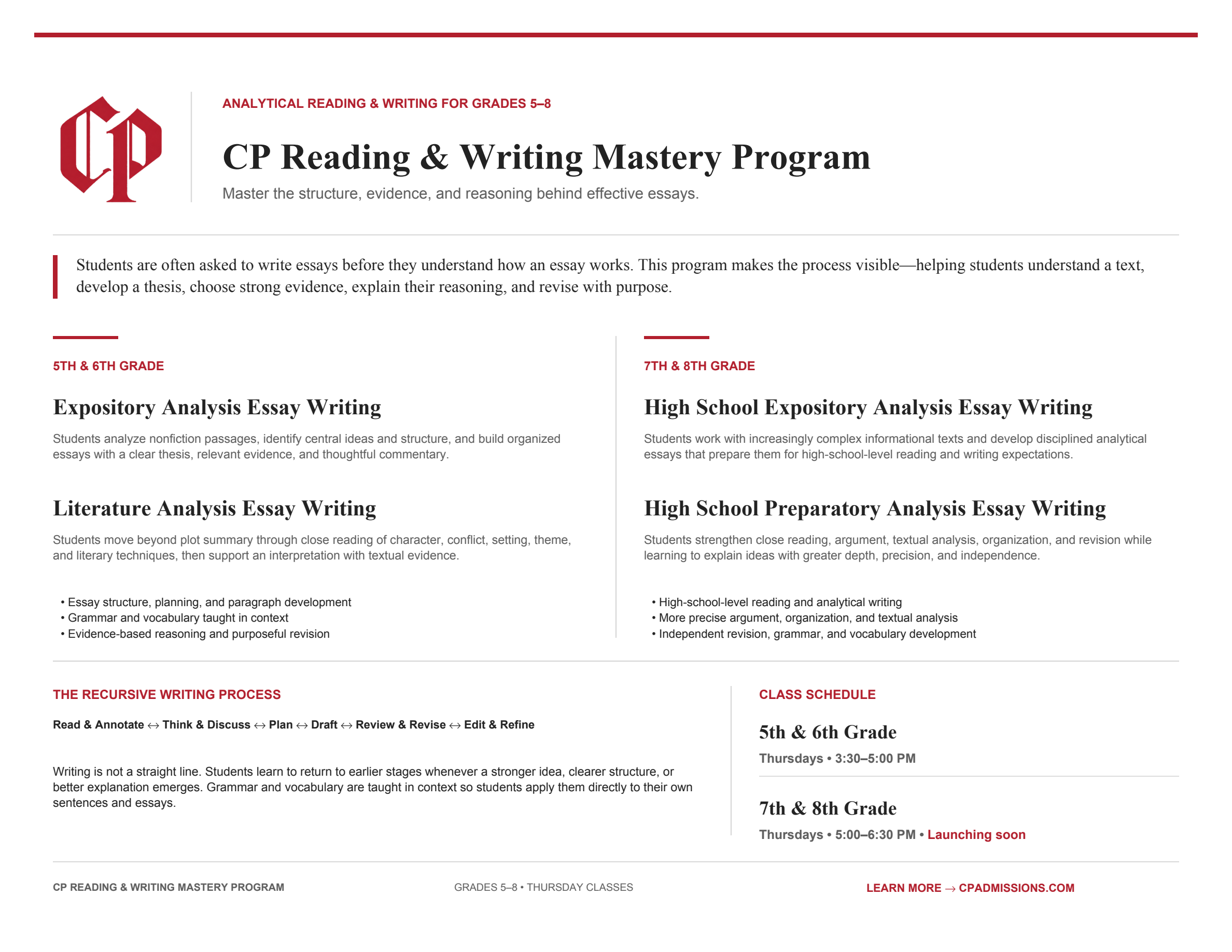
Many students are asked to write essays before they fully understand how an essay works. They may have ideas, but they do not yet know how to turn those ideas into a clear thesis, organize supporting points, select relevant evidence, or explain why that evidence matters.
The CP Reading & Writing Program makes these invisible skills visible.
Students study the fundamental units of effective writing—from the thesis and supporting details to textual evidence and insightful commentary. They then apply those skills to both expository passages and works of literature.
The goal is not simply to complete another essay. It is to develop a repeatable method students can use whenever they read, think, and write.
Two Complementary Areas of Study
Expository Analysis Essay Writing
Students read engaging nonfiction passages drawn from subjects such as science, history, society, and culture. They learn to identify the topic, main idea, author’s purpose, supporting points, patterns of organization, and relationships among ideas.
Students then use their reading to plan and write organized analytical essays.
They learn how to:
Read and annotate expository passages actively
Distinguish main ideas from supporting details
Recognize organizational patterns such as cause and effect, comparison, contrast, sequence, and classification
Draw reasonable inferences
Form a clear and defensible thesis
Organize major and minor supporting points
Use facts, logic, and expert opinion as support
Explain how evidence supports an idea
Write purposeful introductions, body paragraphs, and conclusions
Revise for clarity, organization, grammar, and style
Literature Analysis Essay Writing
Students learn to move beyond recounting what happened in a story. Through close reading and discussion, they examine how authors use character, conflict, setting, imagery, symbolism, point of view, and other literary choices to develop meaning.
Students then turn their interpretations into focused literary analysis essays supported by textual evidence.
They learn how to:
Read stories and literary excerpts closely
Identify important details and patterns
Analyze character, conflict, setting, and theme
Recognize literary techniques such as imagery, metaphor, symbolism, irony, and foreshadowing
Develop an interpretive thesis
Select and introduce relevant quotations
Connect quotations to original commentary
Explain the significance of textual evidence
Organize a complete literary analysis essay
Strengthen ideas through revision
A Structured, Recursive Writing Process
Good writers do not produce finished essays in a single attempt. They move back and forth among thinking, planning, drafting, reviewing, and revising.
Students learn a practical recursive process:
Read and annotate
Identify important ideas, unfamiliar vocabulary, structural patterns, and evidence.Think and discuss
Ask questions, consider interpretations, and test possible claims.Plan
Develop a thesis and arrange major and minor supporting details in a logical outline.Draft
Turn the plan into an introduction, body paragraphs, and conclusion.Review and revise
Evaluate whether each paragraph supports the thesis and whether the evidence has been fully explained.Edit and refine
Improve grammar, sentence structure, word choice, punctuation, and style.
Students may return to an earlier stage whenever they discover a stronger idea or clearer way to express it. Revision becomes part of thinking—not merely the correction of mistakes.
-
A concentrated 90-minute core integrates:
Close reading of an expository or literary passage
Annotation and comprehension strategies
Grammar and sentence instruction
Vocabulary in context
Essay planning and guided writing
Revision and editing
The remaining class time supports discussion, analysis, feedback, and the application of each week’s skills.
-
Students develop a clear understanding of each part of an essay:
A compelling opening
A bridge that introduces the subject
A focused thesis that answers the prompt
Topic sentences that advance the argument
Relevant and specific evidence
Commentary that explains the evidence
Logical transitions between ideas
Closing sentences that give paragraphs purpose
A conclusion that synthesizes the essay’s main ideas
Special attention is given to supporting details. Students learn that strong support can take different forms—including facts, logical reasoning, examples, and informed expert opinion—and that evidence must be explained rather than simply inserted into an essay.
-
No. The program teaches writing as a sequence of understandable skills. Instruction can help students who struggle to organize their ideas as well as capable writers who need to develop deeper analysis and more precise expression.
-
Expository analysis focuses primarily on nonfiction texts and the organization of information, explanations, and arguments. Literature analysis examines how authors use characters, conflicts, settings, language, and literary techniques to create meaning.
Both forms require close reading, critical thinking, a clear thesis, relevant evidence, logical organization, and thoughtful commentary.
-
Grammar is explicitly taught, but students also apply it directly to their sentences and essays. This helps them understand how grammatical choices affect clarity and meaning.
-
The goal is to have NO homework.
We would like to see all the student's’ work in our center under supervision.
However, some assignments may include reading, essay drafting, revision, grammar practice, vocabulary study, and essay revisions.

Essay Writing
Build your informative and persuasive essays with clear structure and offer insightful analysis to convey a compelling and memorable message.

Creative Writing
Use clear plot structure and narrative writing techniques to bring your stories to life for your readers and hold their attention.

Writing Conventions
Follow the commonly used writing conventions to avoid confusion and help you readers rapidly read and digest what you have written.

Writing Style
Apply these tips to improve the flow and power of your sentences.

Common Mistakes
Watch out for these common writing mistakes.